AI Marketing Is Evolving Faster Than Anyone Predicted
Two years ago, "AI marketing" meant scheduling social posts and maybe running an email subject line through a generator. Today, AI is running bid strategies, writing and publishing content autonomously, generating video at broadcast quality, personalizing every customer touchpoint in real time, and beginning to run entire campaigns with minimal human direction.
The pace isn't slowing down. Understanding the future of AI marketing — where it's going in the next 12-36 months — is no longer optional for serious marketers. These trends will reshape budgets, team structures, required skill sets, and competitive dynamics. The brands and practitioners that get ahead of them will pull away from the ones that wait and react.
Here are the 10 trends that will most significantly reshape marketing in the near term.
Trend 1: Autonomous AI Marketing Agents
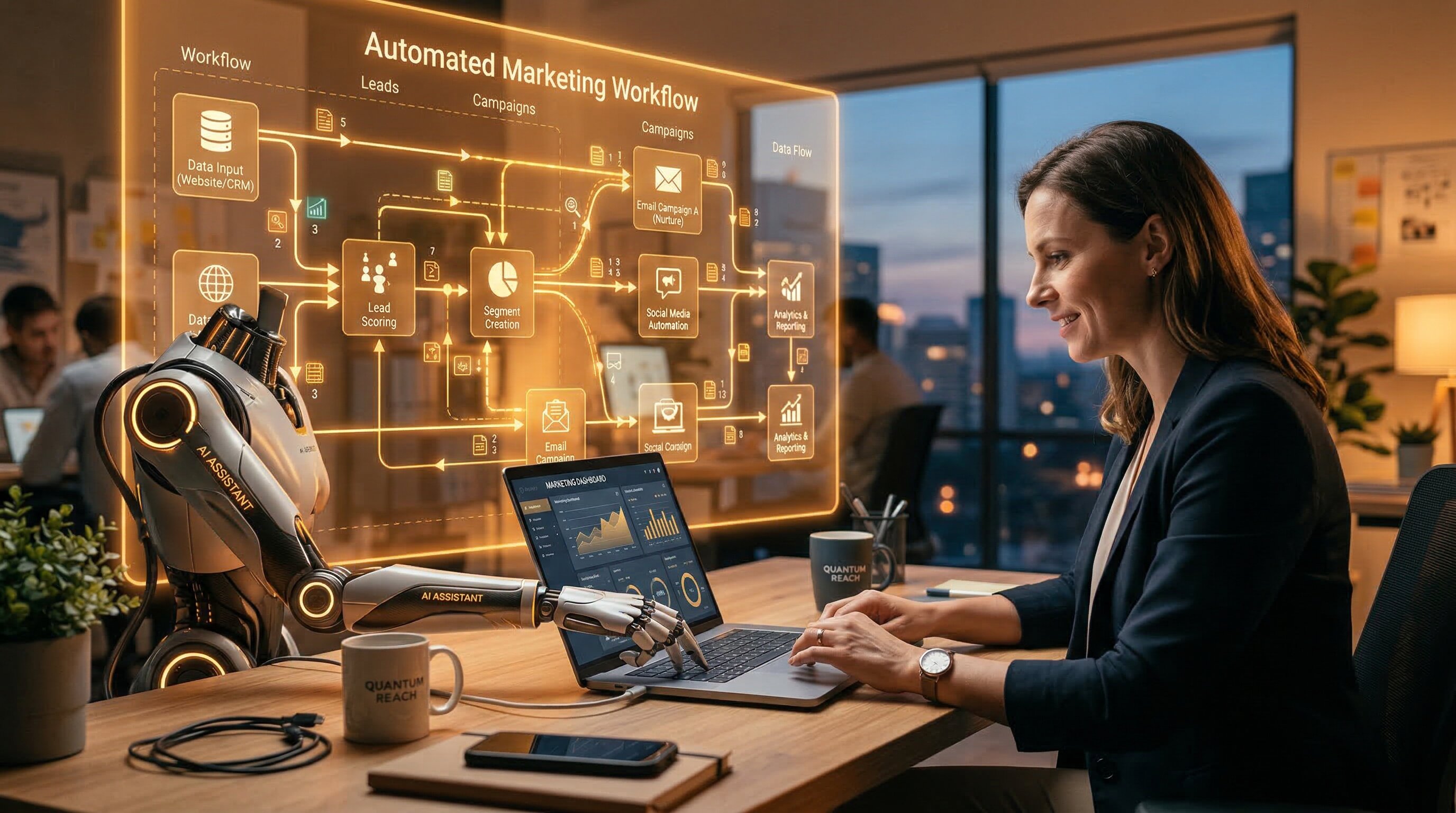
In 2026, AI agents are moving beyond single-task assistance into multi-step autonomous execution. An AI marketing agent can now receive a high-level objective — "generate 500 qualified leads in Q2 from LinkedIn" — and independently plan the campaign, write the content, set up the sequences, test variants, and optimize toward the goal while reporting progress.
This isn't science fiction. Platforms like Jasper Campaigns, HubSpot's AI, and emerging agent-first tools are already demonstrating autonomous campaign execution. The trend will accelerate rapidly. The marketer's role shifts from executor to orchestrator — setting goals, providing brand guardrails, and reviewing outcomes. Browse our AI agent resources for current tool options.
Trend 2: Search Is Being Reinvented (Again)
AI-generated answers in Google, Bing, and Perplexity are fundamentally changing the search traffic model. When AI summaries answer queries directly on the results page, click-through rates to traditional organic results drop. Early data suggests AI overviews are reducing clicks for informational queries by 20-40%.
The response for marketers: shift from traffic-oriented SEO toward authority and citation-oriented SEO. The goal is no longer just ranking #1 — it's being the source that AI search engines reference and cite. This requires deeper, more authoritative content and a stronger focus on building verifiable expertise signals. Understanding this shift is a core module in the Marketer Tribe Challenge.
Trend 3: Hyper-Personalization Becomes the Baseline
By 2027, batch-and-blast email and generic website experiences will be as obsolete as newspaper classified ads. AI marketing trends 2026 data consistently point to one-to-one personalization at scale becoming the minimum acceptable standard for customer communication.
Brands that personalize based on real behavioral signals will see dramatically better retention and conversion. Brands that don't will face increasing irrelevance — not because competitors are dramatically outspending them, but because AI has made personalization so cost-effective that not doing it becomes a choice, not a constraint.
Trend 4: First-Party Data Becomes the Decisive Asset
Third-party cookies are gone. Walled gardens are getting taller. Regulatory pressure on data privacy is intensifying globally. The future of AI marketing runs on first-party data — behavioral signals, purchase history, and preferences that your audience has directly shared with you.
AI makes first-party data dramatically more valuable by extracting insights and predictions that would be impossible to derive manually. The brands investing now in data collection infrastructure, consent frameworks, and clean CRM hygiene will have a compounding advantage as AI capabilities improve. Those without good first-party data will find AI's personalization capabilities largely unavailable to them.
Trend 5: AI-Native Creative Is Leveling the Playing Field
Production quality is no longer a differentiator for mid-market and small brands. AI video generation, AI design tools, and AI voiceover and music platforms have collapsed the production cost gap between brands with million-dollar creative budgets and teams of one. A solo marketer with access to Midjourney, Runway, HeyGen, and ElevenLabs can produce ad creative that competes visually with major brand campaigns.
The new creative differentiator is strategic quality — the insight behind the creative, the message, the targeting precision, and the testing velocity. AI handles production. Humans provide the strategic and emotional intelligence. Explore how this plays out in our AI creative workflow guides.
Trend 6: Voice and Multimodal Interfaces Change Discovery
Voice search has been "the next big thing" for a decade. What's different now is the sophistication of AI voice interfaces. Apple Intelligence, Google's Gemini integration, and AI-native smart devices are creating genuinely useful voice-first experiences where consumers research and discover products without ever looking at a screen.
For marketers, this means optimizing for conversational queries, structured data that AI assistants can parse, and brand recognition that translates to voice recall. "Find me a good AI marketing community" is a query that a voice AI will answer — and the brands that show up in that answer will have invested in both authority signals and AI-parseable content structure.
Trend 7: Predictive Marketing Becomes Standard
Predictive analytics — understanding what individual customers are likely to do before they do it — will move from competitive advantage to table stakes over the next 24 months. Marketing technology future roadmaps across every major platform show predictive features being added to tools at every price point.
Predictive churn models, purchase probability scoring, content performance forecasting, and dynamic budget allocation will be standard features in mid-market marketing stacks by late 2026. Marketers who learn to work with predictive models now will be years ahead of those who wait for these features to be packaged as one-click buttons. See our predictive analytics guide to get started.
Trend 8: The Human-AI Collaboration Model Matures
The "AI replaces marketers" narrative is giving way to a more nuanced reality: AI augments marketers dramatically, but the marketers who thrive are those who develop specific skills that AI amplifies rather than replaces.
Strategic thinking, brand voice development, relationship building, ethical judgment, creative direction, and community leadership — these are human skills that become more valuable as AI handles execution. The marketers who will be most in demand in 2028 are those who are fluent in AI tooling and skilled at the human dimensions of marketing. Communities like Marketer Tribe exist precisely to develop both.
Trend 9: AI-Powered Community and Social Commerce Merges
Social platforms are aggressively integrating AI into commerce. Instagram, TikTok, and YouTube are building AI recommendation engines that connect content consumption directly to purchase — collapsing the funnel from discovery to checkout into seconds. AI identifies when a viewer's engagement patterns suggest purchase intent and surfaces frictionless buying options in the moment.
For marketers, this changes influencer strategy, content formats, and attribution models. The brands investing in shoppable content, creator partnerships, and platform-native AI optimization now will be positioned to capture this shift. Explore how this fits into a full AI in digital marketing strategy in our complete funnel guide.
Trend 10: Responsible AI Marketing Becomes a Competitive Differentiator
As AI-generated content, AI-generated imagery, and AI-generated video proliferate, authenticity and transparency are becoming brand assets. Consumers are developing sophisticated sensitivity to AI-generated communications — and some are beginning to reward brands that are explicit about their AI use and demonstrate genuine human values behind the technology.
Responsible AI marketing — being transparent about AI-generated content, maintaining ethical data practices, avoiding manipulative personalization, and ensuring AI outputs reflect genuine brand values — will shift from a regulatory compliance issue to a genuine trust and differentiation strategy. The brands that navigate this thoughtfully will build deeper customer relationships than those that deploy AI purely for efficiency without ethical guardrails.
The future of AI marketing belongs to practitioners who combine technical AI fluency with strategic and human marketing skills. That combination is exactly what we're building at Marketer Tribe. The curve is steep, but the advantage for early movers is enormous.
Stay ahead of every major AI marketing trend with the Marketer Tribe community. Get weekly insights, early tool reviews, and a network of practitioners who are living these trends in real time.
View Membership Plans