The AI Marketing Strategy Most Teams Are Getting Wrong
Most marketers are using AI tactically — generating a bit of copy here, summarizing a report there. That's fine as a starting point. But in 2026, that's the equivalent of buying a Formula 1 car and using it to run errands. You're barely scratching the surface of what's available, and your competitors who think more strategically are accelerating past you.
A complete AI marketing strategy 2026 isn't about adopting every AI tool on the market. It's about rebuilding how you plan, execute, and measure marketing from the ground up — with AI as a structural component at every layer, not an afterthought bolted on at the end.
This guide covers the full framework: how to audit your current state, which AI capabilities to prioritize, and how to build a 12-month roadmap that compounds results over time.
Phase 1 — Audit: Where Does AI Fit in Your Current Stack?
Before you build anything new, you need to understand what you already have. Conduct a brief AI capability audit across four dimensions:
Content production: Are you using AI to generate first drafts, repurpose content across channels, and scale production without proportionally scaling headcount? If content is still entirely hand-crafted for every piece, this is your highest-leverage starting point.
Data and analytics: Are your analytics tools surfacing AI-powered insights, or are you still manually combing through spreadsheets? AI-assisted reporting and predictive analytics are mature technologies in 2026 — not using them means slower decisions.
Personalization: Are your emails, landing pages, and ad experiences the same for every visitor? Dynamic content personalization powered by AI is now accessible at every budget level — not just enterprise.
Automation workflows: Which repetitive marketing tasks are still being done manually? Lead scoring, follow-up sequences, social scheduling, competitive monitoring — all of these have mature AI automation options.
Document your current state honestly. The gaps you identify become the basis of your AI marketing plan. For a complete toolkit to support this audit, see our AI marketing toolkit.
Phase 2 — Prioritization: Where AI Has the Biggest Impact
Not every AI investment pays off equally. In 2026, the highest-ROI applications of AI in marketing are:
- Content at scale with quality controls: The brands winning organic search in 2026 are producing 3-5x more content than their competitors — but with AI handling first drafts and human editors ensuring quality and brand voice. This combination is faster and cheaper than fully manual production, and more reliable than fully automated content.
- Predictive lead scoring and segmentation: AI can analyze behavioral signals across your CRM and website to identify which leads are most likely to convert — and surface them to sales or trigger personalized nurture sequences automatically. This single capability has driven 30-50% improvements in pipeline efficiency for teams that implement it correctly.
- Conversion rate optimization: AI-powered A/B testing and multivariate experimentation consistently outperforms manually managed testing. See our detailed guide in the AI marketing resources section for the full playbook.
- Paid media optimization: Meta and Google's AI bidding systems are now extremely sophisticated. The question for marketers isn't whether to use AI bidding — it's how to structure campaigns and feed signals effectively so the AI optimizes toward your actual business goal, not just a proxy metric.
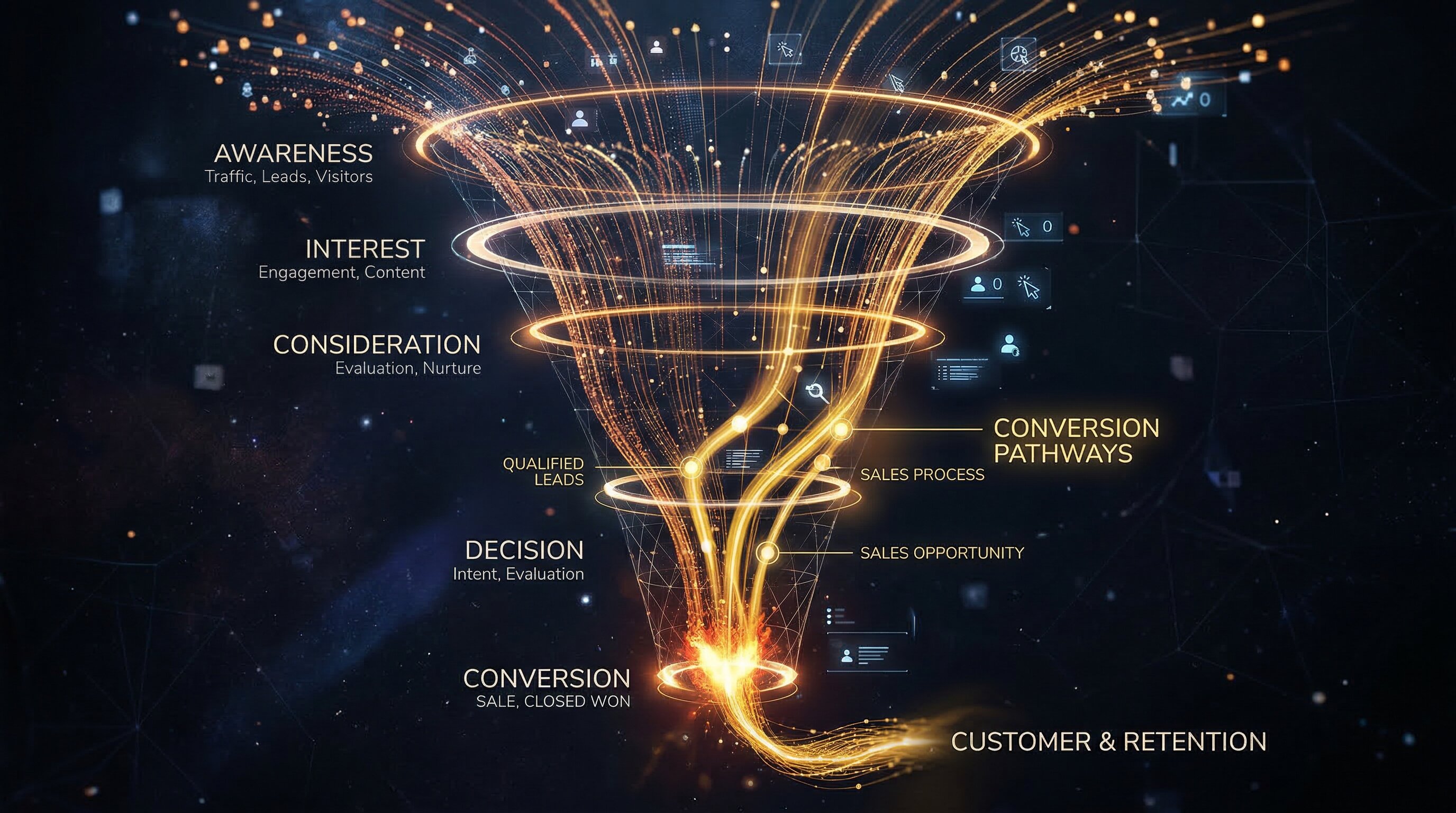
- Customer journey personalization: The funnel is no longer linear. AI can track cross-channel behavior and trigger relevant messages based on real-time intent signals — bridging the gap between what visitors are signaling and what your marketing is saying to them.
Building Your 12-Month AI Marketing Roadmap
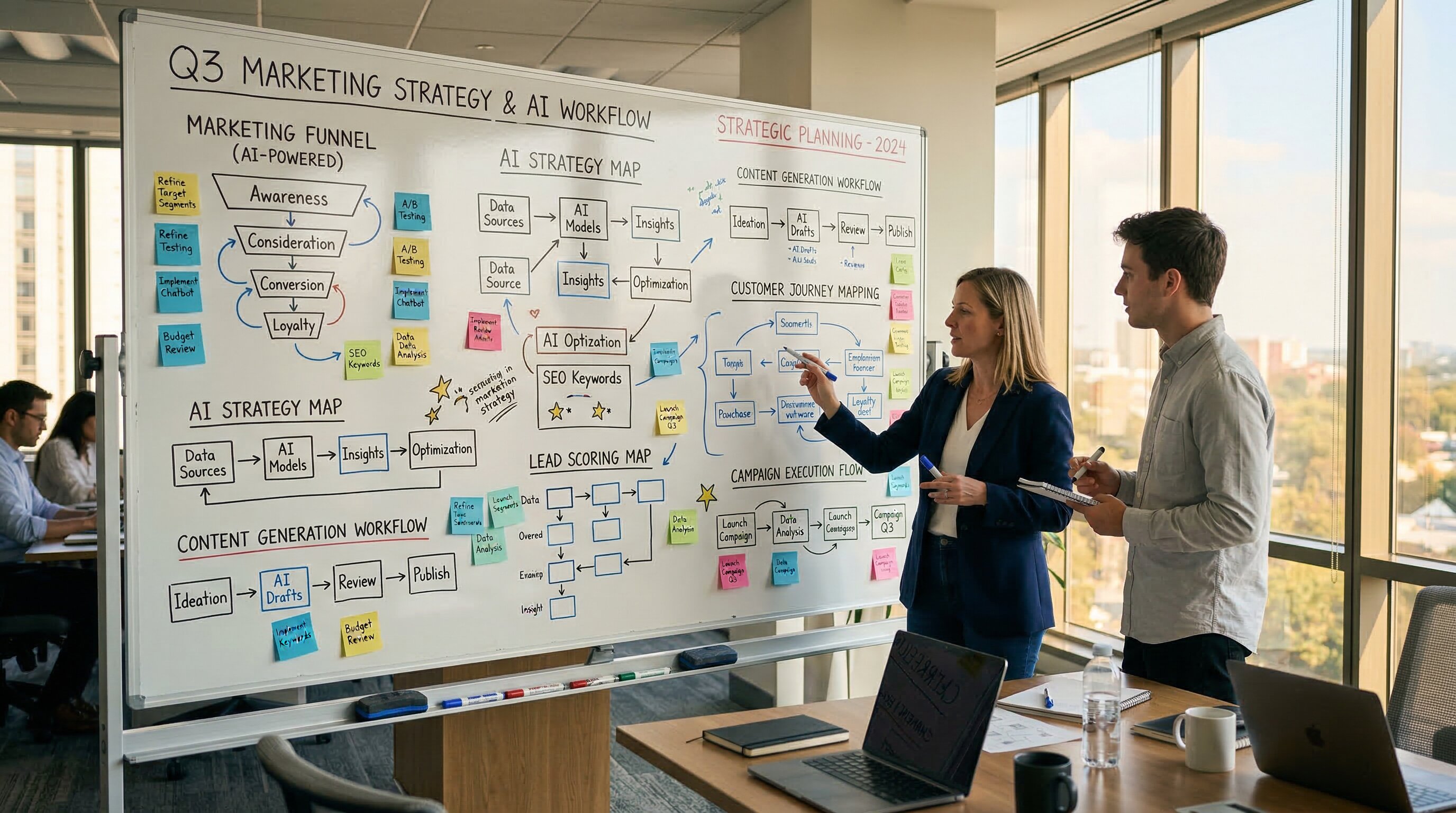
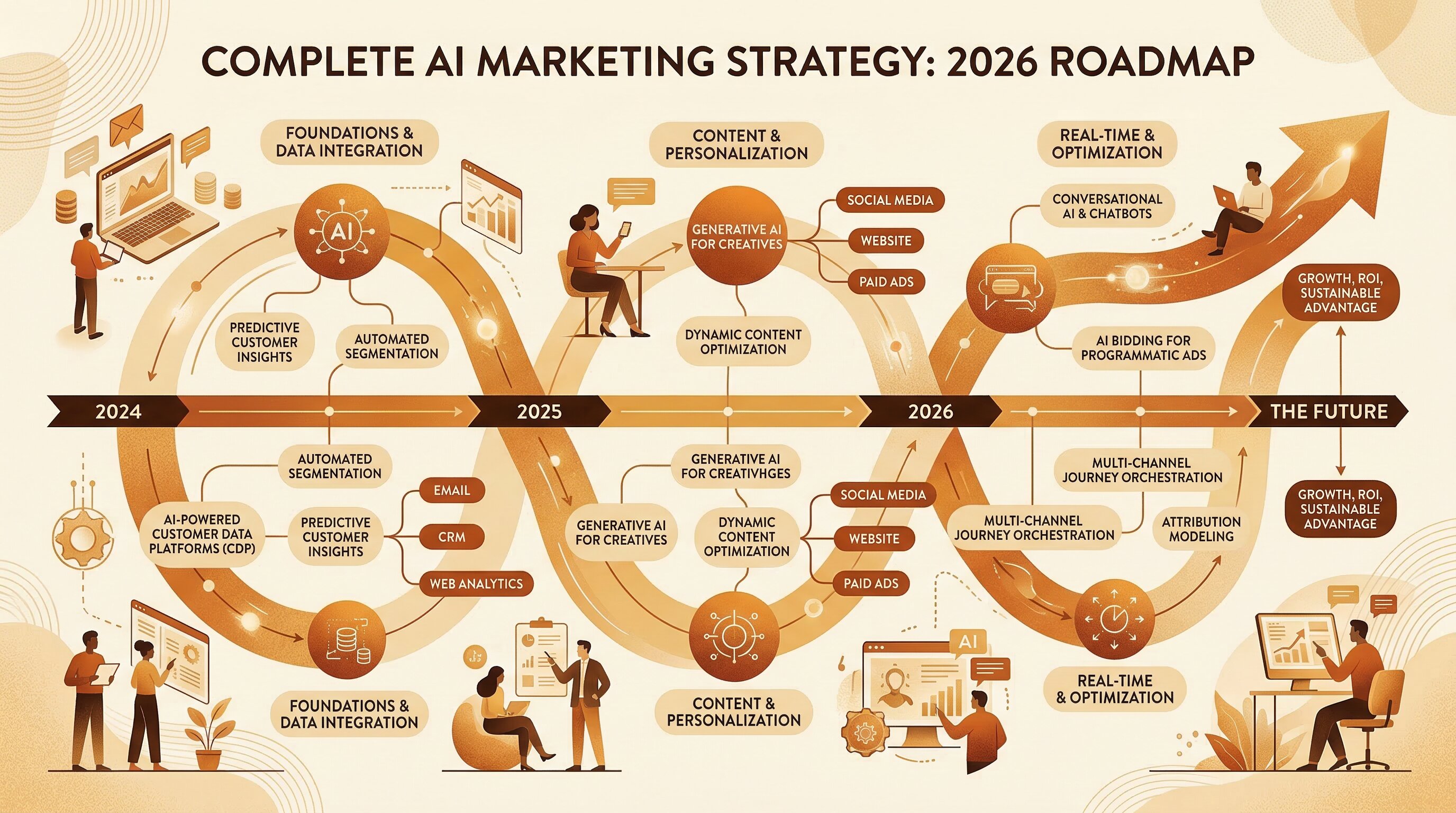
A strong digital marketing strategy AI roadmap is built in three horizons:
Months 1-3: Foundation Layer
Focus here on getting the basics right. Deploy AI for content production (establish a workflow, not just a tool). Set up at least one AI-powered email sequence — welcome series, lead nurture, or cart abandonment. Implement an AI reporting layer so your analytics actually tells you what to do next, not just what happened.
Quick wins in this phase: faster content production, reduced time on reporting, and a baseline automated nurture track that works while you sleep.
Months 4-6: Personalization and Optimization Layer
Now you're building on the foundation. Introduce landing page personalization by traffic source. Launch AI-assisted A/B testing with intelligent traffic allocation. Implement predictive lead scoring if you have enough CRM data. This is also when to start systematic competitive intelligence monitoring using AI tools — see our competitive analysis prompts for templates.
Months 7-12: Integration and Compounding Layer
Connect the dots. Use AI to unify signals across channels — so your email behavior informs your ad targeting, your website behavior informs your sales outreach, and your content performance data informs your next quarter's editorial strategy. At this stage, your marketing operation is genuinely AI-native, not just AI-augmented.
The Metrics That Define AI Marketing Success
You can't manage what you don't measure. Your AI marketing strategy 2026 needs a clear scorecard:
- Content efficiency ratio: Output (pieces published) divided by team hours invested. AI should improve this by 2-3x over 12 months without sacrificing quality.
- Lead-to-close velocity: How long does it take for a lead to become a customer? AI personalization and predictive scoring should compress this timeline.
- Conversion rates by funnel stage: Track visitor-to-lead, lead-to-MQL, MQL-to-SQL, and SQL-to-close rates quarterly. AI interventions should show up as improvement in at least one of these.
- Revenue per campaign: The ultimate metric. AI should be producing measurably better returns on your marketing investment within 6 months of implementation.
- CAC trajectory: Customer acquisition cost should decrease over time as AI automation reduces manual effort and optimization improves conversion rates.
Common Strategy Mistakes to Avoid
Even marketers who are serious about AI tend to fall into these traps:
Tool-first thinking: Buying AI tools before defining the problem they solve is the fastest way to waste budget. Define the capability gap, then find the tool that fills it — not the other way around.
Skipping the quality control layer: Full AI automation without human review degrades brand voice and introduces errors. Build review checkpoints into your AI content workflow from day one.
Siloed implementation: AI marketing tools work best when they share data. A great email tool that doesn't talk to your CRM, which doesn't talk to your ad platform, is a collection of islands. Prioritize integration from the start.
Not building for scale: Design your AI workflows as if you're going to produce 10x the output you currently do. Systems that break at scale aren't worth building. Check out the AI funnel automation guide to see how scalable workflows are structured.
Ready to turn this framework into a done-for-you plan? The Marketer Tribe Challenge walks you through building your complete AI marketing strategy in 30 days, with daily assignments and community accountability.
Start the 30-Day Challenge