Why Most Marketing Funnels Fail (and How AI Fixes It)
The traditional marketing funnel wasn't built for the speed, scale, or personalization that modern buyers expect. Manually managing every stage — from awareness to purchase to retention — requires more human hours than most teams have. Lead fall-through, delayed follow-ups, and generic nurture sequences kill conversion rates that should be much higher.
Marketing funnel automation AI addresses each of these problems at once. AI doesn't just automate tasks — it learns, adapts, and personalizes at a scale impossible to replicate manually. In 2026, the most effective funnels are built on AI-powered infrastructure from top to bottom. Here's how to build one.
Understanding the AI-Powered Funnel Architecture
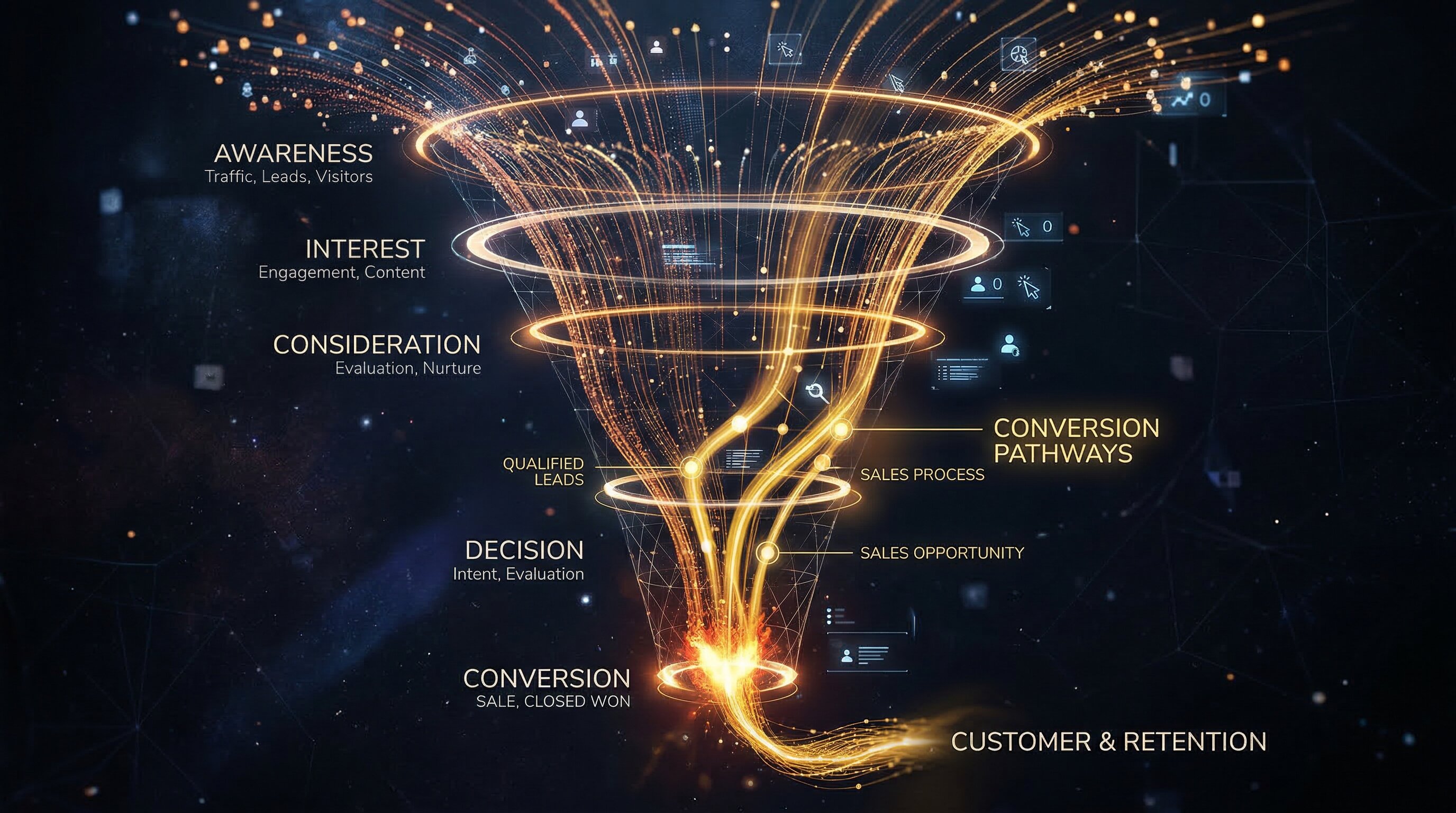
Before touching any tools, map your funnel stages. Every business has variation, but most B2C and B2B funnels follow a similar structure:
- Awareness: Prospect discovers you (SEO, paid ads, social media, referrals)
- Interest: Prospect engages with your content (blog, lead magnet, webinar)
- Consideration: Prospect evaluates your offer (email sequences, retargeting, case studies)
- Decision: Prospect is ready to buy (sales page, checkout, discovery call)
- Retention: Customer buys again and refers others (onboarding, loyalty, community)
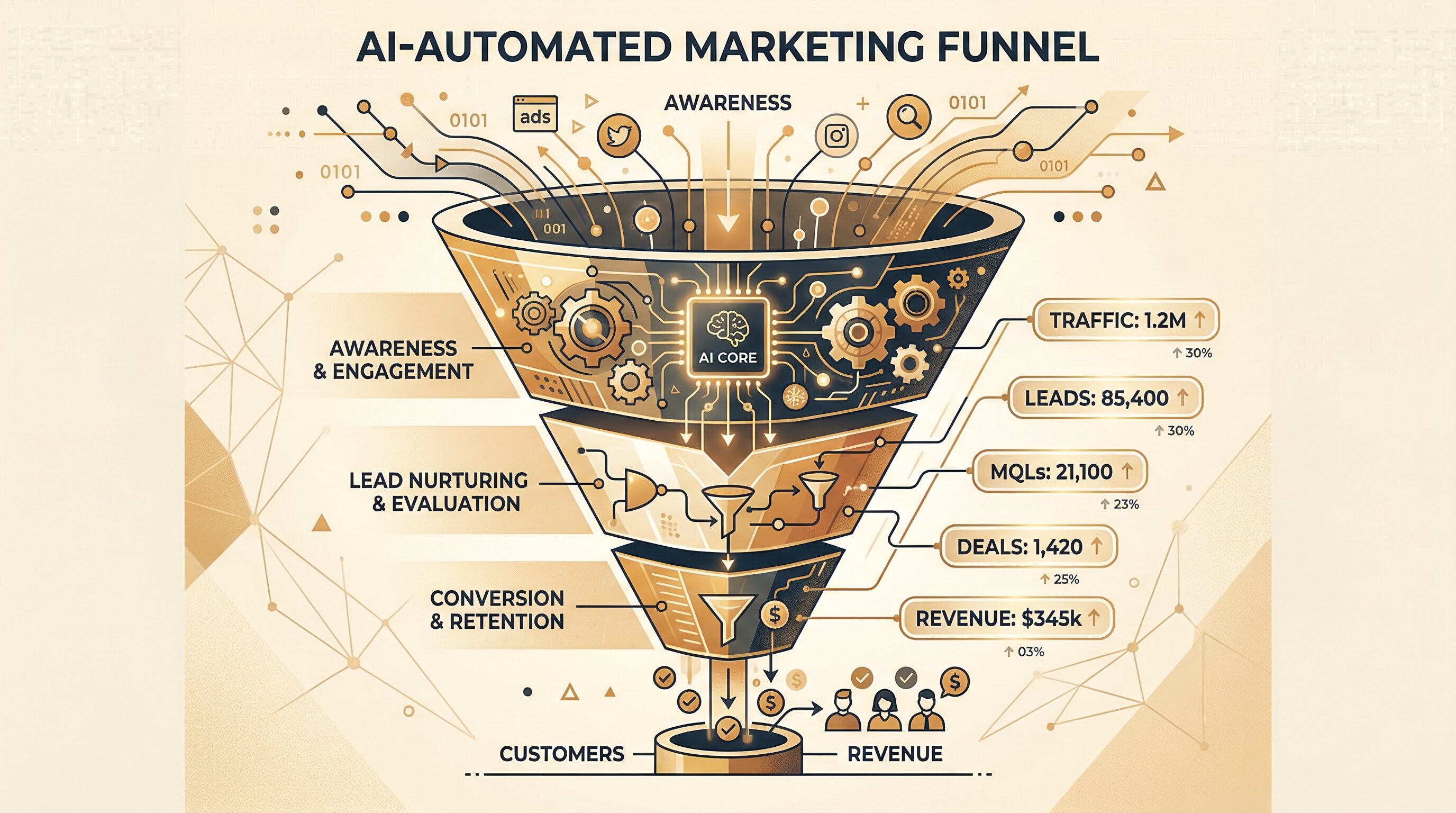
The goal of marketing funnel automation AI is to reduce human intervention at every stage while increasing personalization. AI handles the routing, timing, and content adaptation. Your team focuses on the exceptions, the strategy, and the human moments that actually require a person.
Top of Funnel: AI-Powered Lead Generation and Qualification
The top of your funnel is where volume meets noise. You need to attract large numbers of potential leads while quickly identifying which ones are worth pursuing. AI tools that work here:
AI-powered SEO content: Tools like Surfer SEO combined with ChatGPT allow you to produce optimized blog content at a pace impossible with human writers alone. More quality content means more organic traffic — the highest-ROI, lowest-cost lead generation channel. Connect your content strategy to your funnel builder so every post has a clear lead magnet attached.
AI lead scoring: Platforms like HubSpot and Marketo use machine learning to score inbound leads based on behavior, firmographics, and engagement signals. Instead of sales working through a cold list, they only see leads the AI has flagged as high-intent. This alone reduces wasted sales time by 30–50% in most organizations.
AI chatbots for initial qualification: A conversational AI on your landing page or pricing page can qualify visitors in real time — asking 3–5 targeted questions, collecting contact info, and routing high-value prospects directly to a calendar booking or a sales rep's queue. No form abandonment, no delayed follow-up.
Middle of Funnel: AI-Driven Nurture and Personalization
The middle of the funnel is where most automated sales funnels fall apart. Generic nurture sequences that send the same emails to every lead on the same schedule produce mediocre results. AI transforms this stage through behavioral personalization:
Dynamic email sequences: AI-powered email platforms (Klaviyo, ActiveCampaign, HubSpot) adapt what each lead receives based on their behavior. Someone who clicked your pricing page gets a different next email than someone who downloaded your beginner's guide. The AI makes this routing decision automatically, at scale, for every contact.
Predictive content recommendations: On your website, AI tools like Mutiny or HubSpot CMS Hub serve different content blocks to different visitors based on their industry, behavior history, and funnel stage. A returning visitor who's viewed your pricing page three times sees a demo CTA — not the same generic hero section a first-time visitor sees.
AI-powered retargeting: Paid retargeting campaigns optimized by AI (Facebook/Meta's Advantage+ or Google's Performance Max) automatically test thousands of creative and audience combinations and reallocate budget to what converts. This is marketing automation at the ad platform level that requires almost no manual management once set up.
The Marketer Tribe funnel builder guide walks through exactly how to set up each of these middle-funnel automation layers with step-by-step instructions.
Bottom of Funnel: AI That Closes and Converts
At the decision stage, speed and relevance are everything. AI-powered bottom-of-funnel automation:
Automated proposal and quote generation: For B2B businesses, tools like PandaDoc and Qwilr with AI integrations can generate personalized proposals automatically based on CRM data. A sales rep marks a deal as "proposal stage" and the AI drafts a custom document using the prospect's company name, specific pain points from call notes, and relevant case studies — in minutes.
Abandoned cart and checkout recovery: E-commerce funnels lose 70%+ of revenue at checkout. AI tools detect abandonment patterns and trigger personalized recovery sequences — email, SMS, retargeting — with dynamic content that reflects the specific product the visitor was considering.
AI call scheduling and follow-up: An AI funnel builder approach to closing means automated follow-ups are triggered based on prospect behavior, not sales rep memory. If a prospect watches your demo video but doesn't book a call, an automated sequence goes out within the hour — not the next business day when the rep finally remembers to follow up.
Post-Purchase: AI for Retention and Upsells
The most profitable part of your funnel is the one most marketers neglect: post-purchase. Retaining an existing customer costs 5–7x less than acquiring a new one. AI automates this effectively:
- AI-powered onboarding sequences: Adaptive onboarding that adjusts based on which features a new customer uses (or ignores) in their first 14 days
- Predictive upsell timing: AI identifies customers who are most likely to be ready for an upgrade based on usage patterns, engagement, and purchase history
- Churn prevention: Automated win-back sequences triggered when engagement drops below baseline — before the customer cancels, not after
The compounding effect of a well-built marketing funnel automation AI system is significant. Businesses that implement AI across all funnel stages typically see 25–40% higher conversion rates and 20–35% higher customer lifetime value within the first 12 months.
Visit our marketing resources library for funnel templates, automation blueprints, and conversion rate benchmarks by industry.
Ready to build an AI-powered funnel that runs while you sleep? Explore our complete funnel automation guide and get the exact templates our community uses to convert leads on autopilot.
Build Your AI Marketing Funnel