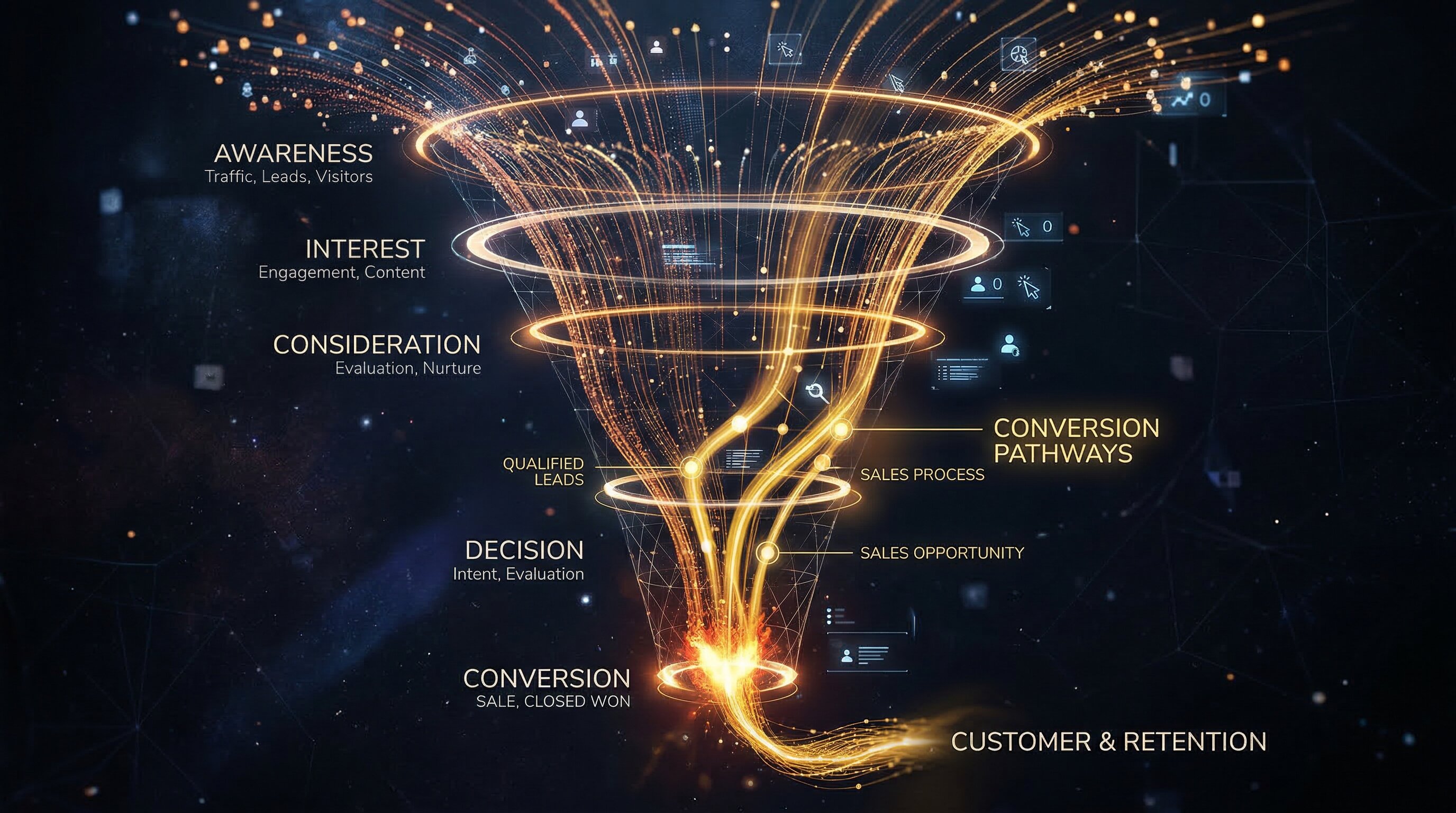
Marketing Data Is Everywhere — Insight Is Rare
The average marketing team is drowning in data. Google Analytics. Your ad platforms. Your CRM. Your email tool. Your social media dashboards. Your heatmap software. Each one generates reports. Together, they generate noise.
The problem isn't a lack of data. It's a lack of interpretation. Most marketing teams spend hours per week pulling reports and summarizing numbers, and then still aren't sure what to actually do differently. That's not analytics — that's data administration.
AI marketing analytics flips this equation. Instead of spending time collecting and formatting data, you spend time acting on insights that AI has already extracted, correlated, and prioritized. The result is faster decisions, fewer blind spots, and measurably better campaign outcomes. Here's how to build that capability.
What AI Actually Does in Marketing Analytics
There's a spectrum of AI analytics capability. Understanding where each type applies helps you prioritize the right investments:
Descriptive AI (what happened): This is where most tools are today. AI automatically generates written summaries of your dashboards — instead of reading a chart, you get a sentence: "Email open rates fell 12% week-over-week, driven primarily by a drop in engagement from mobile subscribers." Tools like Google Analytics 4's insights feature and Klaviyo's reporting layer already do this. It saves time, but it's the least strategically valuable tier.
Diagnostic AI (why it happened): This is where marketing data analysis AI gets genuinely useful. AI correlates data across multiple sources to identify contributing factors. "Conversion rate on your paid search campaigns dropped 18% this month, correlating with an increase in mobile traffic from a new campaign targeting a younger demographic — mobile page load speed is 4.8 seconds for these visitors, significantly above the 2-second benchmark." That's actionable.
Predictive AI (what will happen): Predictive analytics marketing uses historical data to forecast outcomes. Which leads are most likely to convert? Which customers are at churn risk? Which products will need restocking in 30 days? Which email subject line will get the highest open rate for this specific segment? Predictive AI answers these before you launch, not after.
Prescriptive AI (what to do): The highest tier. AI doesn't just identify what will happen — it recommends specific actions to improve outcomes. "Allocate an additional $12,000 to your branded search campaign and reduce spend on display by $8,000 to achieve the same ROAS with 15% better efficiency." This tier is emerging rapidly in ad platform AI and marketing mix modeling tools.
Building Your AI Analytics Stack
The right AI reporting tools depend on your current setup and the questions you most need to answer. Here's a practical stack for 2026:
Web and conversion analytics:
- Google Analytics 4 with AI Insights: The baseline for any digital marketing operation. GA4's AI-powered anomaly detection and predictive audiences are powerful and free. If you're not using GA4 predictive segments (purchase probability, churn probability), you're leaving insight on the table.
- Hotjar or FullStory: Behavioral analytics that shows how visitors actually interact with your site. Both now have AI-powered session summaries — instead of watching hundreds of session recordings, AI surfaces the patterns for you.
Multi-channel reporting:
- Northbeam or Triple Whale: AI-powered attribution for e-commerce and DTC brands. These tools solve the multi-touch attribution problem — instead of giving all credit to last click, they model the true revenue contribution of each channel. Essential for any brand running ads across multiple platforms.
- Supermetrics + AI layer: Pull data from all your marketing platforms into one place, then use AI to analyze cross-channel patterns. Works well with Google Sheets, BigQuery, or Looker Studio.
Predictive and prescriptive analytics:
- HubSpot AI features: If you're a HubSpot user, their predictive lead scoring, AI-powered forecasting, and conversation intelligence tools add substantial analytical value without adding another platform.
- Pecan AI or Obviously AI: Accessible predictive analytics platforms that don't require a data science team. Connect your data sources, define what you want to predict, and get models running in days rather than months.
Find a curated comparison of these tools at our AI marketing analytics resource hub.
5 Analytics Questions AI Can Now Answer for You
Here are five specific questions that AI marketing analytics can now answer that used to require either a data analyst or a week of manual work:
- "Which channels are actually driving revenue, not just traffic?" Multi-touch attribution models powered by AI give you an honest picture of channel contribution. Most brands discover that their SEO investment is worth far more than last-click analytics suggested — and that some paid campaigns are less efficient than they appear.
- "Which customer segment has the highest lifetime value?" AI cohort analysis on your purchase data identifies the characteristics of your best customers — acquisition source, first purchase category, purchase frequency pattern — so you can acquire more of them.
- "Why did our conversion rate drop last week?" AI diagnostic tools cross-reference multiple data sources to identify likely causes rather than leaving you to correlate manually. Was it a traffic quality shift? A form issue? A price change? A page load problem? AI surfaces the probable answer.
- "Which leads should our sales team prioritize?" AI predictive lead scoring analyzes hundreds of behavioral and demographic signals to rank your leads by conversion probability. In testing, AI scoring consistently outperforms human intuition and simple rule-based scoring.
- "How should we reallocate budget next month?" AI marketing mix models and optimization tools can analyze your historical spend-to-revenue relationships across channels and recommend specific budget shifts to improve efficiency.
The Insight-to-Action Framework
AI analytics only produces value when it changes decisions. Build this simple framework to close the gap between insight and action:
Weekly review cadence (30 minutes): Every Monday, review AI-generated anomaly alerts and summary reports from your core analytics platforms. Flag anything that represents a change from baseline — positive or negative. Don't spend time on what's flat or trending as expected.
Hypothesis and action log: For every significant insight, document three things: the observation, the hypothesized cause, and the specific action you'll take to test or respond. This keeps your analytics work from being passive and builds institutional knowledge over time.
Monthly attribution review: Once a month, review your multi-touch attribution model to ensure budget allocation reflects where revenue is actually coming from. Reallocate if data suggests it's warranted. Review our funnel analytics guide for a detailed attribution walkthrough.
Quarterly predictive deep-dive: Every quarter, run your predictive models against the coming quarter's goals. Which leads need nurturing before they go cold? Which customers are churn risks? Which campaigns are likely to underperform based on early signals? Act on predictions, not just history. Use our analytics interpretation prompts to accelerate the process.
Stop drowning in dashboards. Get the complete AI analytics framework — including tool recommendations, prompt templates, and the exact questions to ask your data every week.
Get Free Analytics Resources