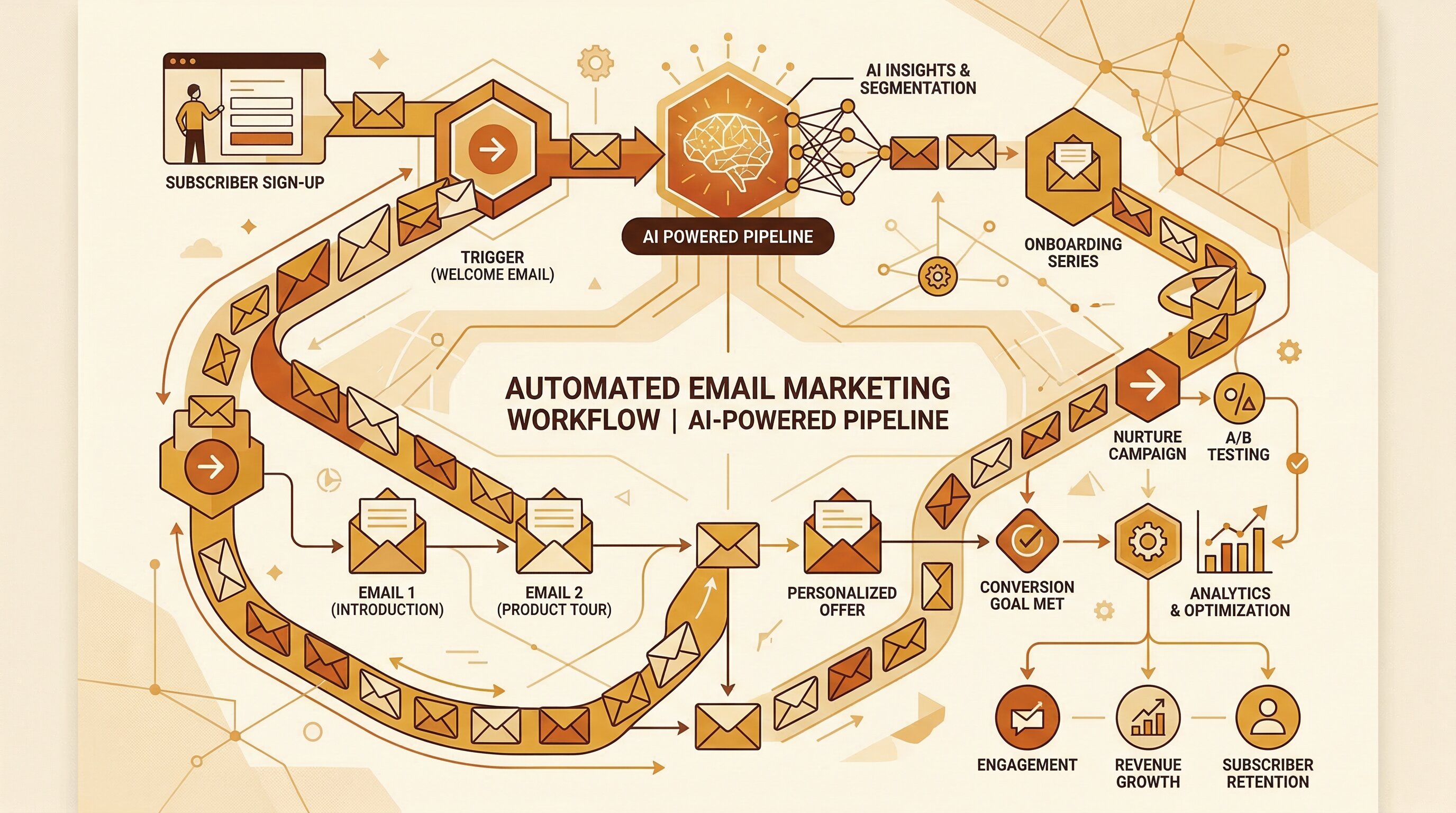
What Is AI Email Marketing Automation (and Why Does It Matter)?
Email marketing has one of the highest ROIs in the digital marketing playbook — $36 back for every $1 spent, according to industry benchmarks. But most marketers are still running their email programs the old way: manually segmenting lists, writing every subject line from scratch, and guessing at send times. That's where AI email marketing automation changes everything.
AI doesn't just schedule your emails — it learns from your audience's behavior, personalizes content at scale, and continuously optimizes your campaigns without you lifting a finger after the initial setup. This guide walks you through exactly how to implement it, even if you've never touched an automation workflow before.
How AI Email Marketing Automation Actually Works
Traditional email automation is rule-based: "If someone downloads an ebook, send email A. If they don't open it in 3 days, send email B." It's better than blasting your whole list, but it's still dumb. Every subscriber gets the same sequence.
AI email personalization takes this further in three key ways:
- Predictive send time optimization: AI analyzes when each individual subscriber historically opens emails and delivers to them at that exact moment — not just "Tuesday at 10 AM" for everyone.
- Dynamic content blocks: The same email renders differently based on the recipient's behavior, preferences, and purchase history. Someone who clicked your pricing page sees different content than someone who only read your blog posts.
- AI-generated subject lines: Tools like Mailchimp and Klaviyo now test dozens of subject line variations automatically, learning which language drives opens for your specific audience over time.
The result is automated email campaigns that feel hand-crafted — because the AI is making thousands of micro-decisions to match each email to each person.
Choosing the Right AI Email Marketing Platform
Before you build your first automated sequence, you need to pick the right platform. Here's a quick breakdown of the top options for beginners:
- Klaviyo — Best for e-commerce. Its AI features are deeply integrated with purchase data, making it exceptional for abandoned cart flows, product recommendation emails, and win-back campaigns. Starts free up to 250 contacts.
- Mailchimp — Best for beginners. The AI assistant helps write emails, and the free plan supports up to 500 contacts. Predictive demographics and send-time optimization are available on paid plans.
- ActiveCampaign — Best for complex automation. If your sales process involves multiple touchpoints across email, SMS, and CRM, ActiveCampaign's visual automation builder paired with AI scoring is hard to beat.
- HubSpot — Best for B2B. Integrates email with your CRM, lead scoring, and content strategy. The AI features become especially powerful when you connect email behavior to sales pipeline activity.
Check out the Marketer Tribe resource library for our full comparison of email platforms with pros, cons, and pricing breakdowns.
Setting Up Your First AI-Powered Email Sequence
Here's a step-by-step approach to getting your first AI email marketing automation workflow live in under an hour:
- Define your trigger. What action starts the sequence? Common triggers: form submission, content download, product purchase, free trial signup, or cart abandonment.
- Map your sequence. Most welcome sequences run 3–5 emails over 7–14 days. Day 1: Deliver what you promised + introduce your brand. Day 3: Share your best content or case study. Day 7: Make a soft offer or invite them to a community/resource.
- Write your emails. Use ChatGPT or your platform's AI assistant to draft the body copy. Be specific in your prompts: "Write a 150-word welcome email for a free AI marketing community. Tone: friendly but direct. CTA: join the private Slack group." Visit our AI prompts library for proven email writing prompts.
- Set up AI optimization. Enable send-time optimization and subject line A/B testing in your platform settings before activating the sequence.
- Go live and monitor. Track open rates, click rates, and unsubscribes for the first two weeks. Most platforms will automatically optimize based on this data.
Advanced AI Email Tactics That Drive Real Results
Once your basic automation is running, these advanced tactics separate good email marketing AI programs from great ones:
Behavioral segmentation: Instead of segmenting by demographics, let AI group your subscribers by behavior — who clicks pricing links, who reads long-form content, who only opens promotional emails. Each segment gets different messaging that matches what they've shown they care about.
Churn prediction: AI can flag subscribers who are likely to disengage before they actually unsubscribe. Platforms like ActiveCampaign and Klaviyo score engagement over time and can trigger re-engagement sequences automatically when someone starts going cold.
AI-powered spam filter avoidance: Modern deliverability tools use AI to flag copy that's likely to hit spam folders before you send. Run every campaign through a tool like GlockApps or your platform's built-in checker.
Revenue attribution modeling: AI can now attribute revenue back to specific emails with far more accuracy than last-click models. This tells you which parts of your automated email campaigns are actually driving sales, not just opens.
Common Mistakes to Avoid with AI Email Automation
A few pitfalls that trip up beginners:
- Setting it and forgetting it completely. AI optimizes, but it doesn't manage. Review your automation performance monthly and update copy that's more than 6 months old.
- Over-automating too fast. Build one sequence well before adding more. A broken welcome sequence damages trust with every new subscriber.
- Ignoring list hygiene. AI can't fix a dirty list. Clean out hard bounces and long-term non-openers every quarter to protect your sender reputation.
- Generic AI copy. The AI can draft, but your voice needs to come through. Edit the output to match your brand personality before sending to your list.
The Marketer Tribe 30-Day AI Challenge walks you through building a complete AI email marketing automation system from scratch over 30 days — with daily tasks, templates, and accountability built in.
Measuring Success: What Good Looks Like
Industry average email open rates sit around 20–25% for most sectors. Click-through rates average 2–5%. With well-implemented AI email personalization, expect:
- Open rates: 30–45% (welcome sequences often hit 50%+)
- Click-through rates: 4–8%
- Unsubscribe rates: below 0.5% per send
If your numbers are below these benchmarks after 30 days, your copy, offer, or segmentation needs attention — not more automation. Get our email audit checklist to diagnose what's off.
Want the exact email templates and automation blueprints we use? Join Marketer Tribe and get instant access to our full library of AI email marketing resources.
Join Marketer Tribe